


How should UK trades choose a Local SEO service?
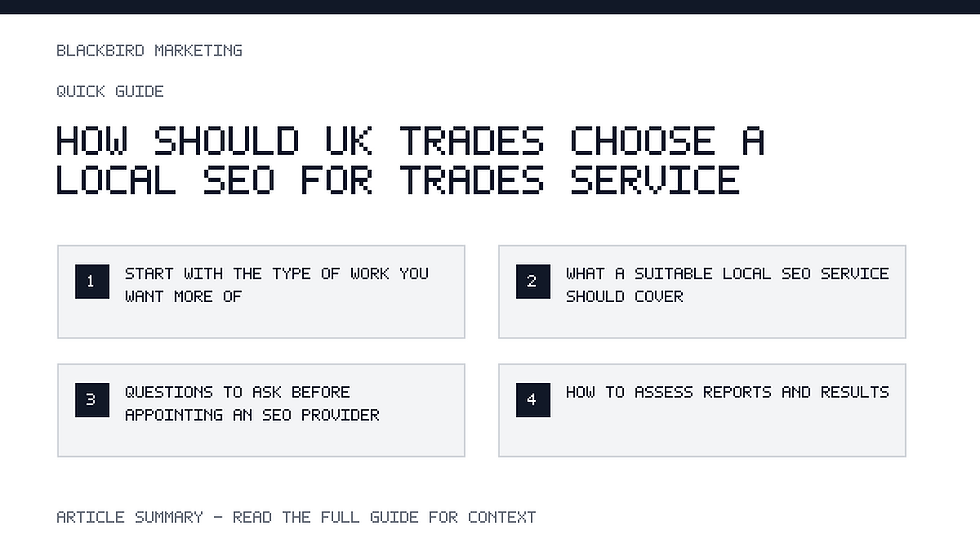
UK trades should choose a local SEO service based on its understanding of trade businesses, the work included and the quality of its reporting, rather than promises about reaching number one. A useful provider should be able to explain how it will improve your website, Google Business Profile and local search visibility, and how those changes relate to enquiries.
Before signing up, check exactly what is included, who owns the accounts and website work, how success will be measured, and whether the service suits the way your business operates. A plumber handling urgent call-outs may need a different approach from an electrician targeting planned commercial work or a building firm covering a wider area.
In short: Choose a local SEO provider that can clearly explain what it will change, how it will measure useful enquiries and who will own the website, profiles and data. Compare the work included and the quality of the reporting rather than promises about rankings. Local SEO is not simply about appearing for the name of your trade. The useful question is which jobs you want to attract and where you can properly serve them. Write down the services that are most valuable to the business. These might include boiler repairs, rewires, inspections, roofing work, extensions or maintenance contracts. Also note any work you do not want, areas you do not cover and jobs that regularly produce poor-quality enquiries. This gives a potential SEO provider something practical to work from. It also helps prevent a campaign from chasing broad searches that generate website visits but few suitable enquiries. Your website should make it clear what you do, where you work and how a customer can contact you. A local SEO service may review page structure, page titles, headings, internal links, contact details, mobile usability and the information customers need before calling. Each important service should have a clear page where there is enough useful information to answer a genuine customer need. Location pages can be useful where they reflect real areas served and contain relevant information. Creating thin pages that only change a place name can make the website harder to trust and less useful to visitors. Your Google Business Profile is often one of the first places a local customer sees your business. Ask whether the service includes checking the business category, contact details, opening information, service description, photos, services and profile activity. The details should match your website and the way you actually operate. A tradesperson who works at customers’ properties may need a service-area setup rather than publishing a private address. The correct arrangement depends on the business and the platform’s rules, so a provider should ask questions before making changes. Local SEO also involves making sure important business details are consistent across relevant websites and directories. The focus should be on accuracy and usefulness, not submitting your details to every directory available. Ask which listings will be reviewed, whether incorrect information will be corrected and whether you will receive a record of the work. This matters particularly if the business has changed its phone number, trading name, address or service area. A provider can help you put a sensible process around requesting reviews, but reviews must reflect genuine customer experiences. Be wary of anyone offering to create reviews, remove legitimate criticism or use incentives in a way that breaches platform rules. Reviews are only one part of the decision. Customers may also look at photographs, clear service information, recent activity, contact options and whether the business appears suitable for their particular job. A provider should answer these questions in plain English. If the explanation depends mainly on technical terms, traffic figures or promises of guaranteed rankings, ask for a clearer explanation of the business benefit. Good reporting should help you decide what to do next. It may include work completed, changes in local visibility, website visits, calls, contact form submissions and the pages or services attracting attention. Ranking data can be useful, but rankings vary by searcher, device, location and search wording. A report showing a position without explaining the search, area or date gives limited information. Enquiry numbers also need context. Ask whether calls and forms are being tracked properly, whether spam has been removed and whether the figures include paid campaigns. A rise in visits is not automatically useful if the visitors are looking for work you do not provide. Local SEO fees vary because the amount of work varies. Cost is likely to be affected by: Be cautious about comparing providers on a monthly figure alone. A cheaper service may include little more than automated reports, while a higher fee may include substantial website work and content. Ask for a written list of deliverables so you can compare like with like. You should also check whether website hosting, copywriting, paid advertising, design work or one-off technical fixes are charged separately. SEO and PPC can work together, but they are different services and should be reported separately. No legitimate provider can control every factor affecting search results. Local SEO usually involves ongoing improvements, testing and accurate information rather than one change that solves everything. SEO is intended to improve unpaid search visibility over time. PPC places paid adverts in eligible search results and can be useful when you need to test demand, promote a particular service or generate visibility while organic work is being developed.
Start with the type of work you want more of
What a suitable local SEO service should cover
Website structure and service pages
Google Business Profile
Local relevance and business information
Reviews and customer trust
Questions to ask before appointing an SEO provider
Which services and search areas will you prioritise, and why?
What will you change on the website during the first stage?
Will you review and improve the Google Business Profile?
Who will write the content, and how will you check that it reflects our actual work?
How will you handle service-area pages?
Which accounts, listings and website assets will remain owned by our business?
What will the monthly report show?
How will you separate organic enquiries from paid advertising enquiries?
What information do you need from us, and how much involvement will be required?
What happens if we decide to stop the service?
How to assess reports and results
Understand what affects the cost
the number of services that need dedicated pages;
the size and complexity of the website;
the number of genuine service areas being targeted;
the condition of the existing Google Business Profile and business listings;
how much new or revised content is needed;
whether technical website work is required;
the level of reporting and ongoing review; and
how competitive the target services and areas are.
Watch for these warning signs
Guaranteed positions, guaranteed enquiries or a fixed date for ranking results.
Promises to make the business rank everywhere without discussing the areas actually served.
Large numbers of location pages with little useful information.
Requests for control of your domain, Google Business Profile or advertising account without explaining access and ownership.
Reports that only show impressions, clicks or rankings with no link to enquiries or useful actions.
Unclear contracts, automatic renewals or no explanation of what happens when the agreement ends.
Recommendations to create fake reviews, duplicate business profiles or other tactics that could put the business at risk.
Decide whether you need SEO, PPC or both
The right mix depends on your work pipeline, margins, competition, available budget and how quickly you need enquiries. Ask any provider to explain which activity is recommended, what it is expected to do and how the results will be measured. Do not treat paid clicks as proof that the SEO work is performing, or organic traffic as proof that every enquiry is profitable.
Choose a provider that understands trade enquiries
A trades-focused provider should understand that a visitor may need to call quickly, compare several firms, check whether the business covers their area or decide whether the job is suitable before making contact. The website and local profile need to support those decisions.
For example, a service page may need to explain the type of work covered, relevant qualifications or registrations where applicable, the areas served, how to request a quote and what information the customer should provide. Only include claims that are accurate and current.
Blackbird Marketing records services including SEO for plumbers, SEO for electricians, Local SEO for Trades, digital marketing for tradespeople and PPC for trades. When comparing any provider, use its service description as a starting point for questions about the work it would actually carry out for your business.
A practical way to compare three providers
Give each provider the same information about your main services, service areas and business priorities.
Ask each one to explain the first pieces of work it would recommend.
Request a clear breakdown of included work, additional charges and reporting.
Check who owns the website, profiles, listings and advertising accounts.
Look at whether the proposal targets suitable enquiries rather than just more website traffic.
Choose the proposal you can understand, check and work with, not simply the one with the strongest promise.
The best choice is usually the service that connects its work to your actual jobs and explains its limits clearly. Before signing, make sure the scope, access arrangements, reporting, charges and cancellation terms are written down.
Want a second opinion on your local SEO?
If you run a trade business and want a clearer view of what is helping or holding back your local search visibility, see how Blackbird Marketing approaches local SEO for trades and compare it against the checklist above.


