.png)
.png)
.png)
How Should a UK Trade Business Choose an SEO Agency?
By Blackbird Marketing
Choosing an SEO agency is not simply a matter of finding the company with the highest search ranking or the most impressive sales presentation. For a plumber, electrician, builder or other trade business, the agency needs to understand local search, service areas, customer enquiries and the commercial value of different jobs.
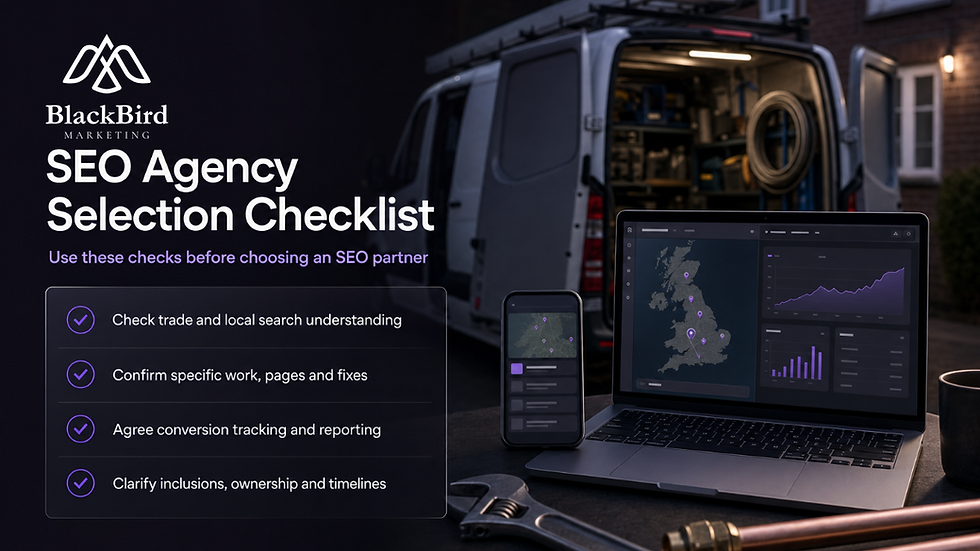
In short: choose an SEO agency that can explain what it will change, why those changes matter to your trade business, how progress will be measured and what you will still own if the relationship ends.
Start with the business problem, not the SEO package
Before speaking to agencies, decide what you actually need SEO to improve. You may want more calls for a particular service, stronger visibility in nearby areas, more work from your existing website or a better return from traffic you already receive.
These are different requirements. A business trying to appear for emergency plumbing searches may need a different plan from an electrician building visibility for rewires, inspections or commercial work. An agency should ask about your services, margins, preferred jobs, capacity and current lead sources before recommending activity.
Check whether the agency understands trade businesses
SEO knowledge is useful, but industry understanding affects the quality of the strategy. Trade businesses often rely on local intent, trust, reviews, phone calls and clear service information rather than large volumes of general website traffic.
Ask how the agency would approach issues such as:
separate pages for distinct services rather than one vague services page;
towns or areas where you genuinely work, without creating misleading location pages;
mobile visitors who want to call or request a quote quickly;
seasonal demand, emergency work and differences between domestic and commercial customers;
tracking calls, forms and useful enquiries rather than reporting visits alone.
A trade-focused provider should be able to discuss these points in plain English. For example, Blackbird Marketing records services including SEO for plumbers, SEO for electricians, local SEO for trades and PPC for trades. That service focus is more relevant to a trade business than a generic promise to increase website traffic.
Ask what the agency will actually do
Be cautious of proposals built almost entirely around phrases such as “boost your rankings” or “increase domain authority”. Those statements do not tell you which pages will change, what technical problems will be addressed or how the work connects to enquiries.
Ask for a clear explanation of the likely work across four areas:
Technical checks
This may include reviewing indexing, page speed, mobile usability, internal links, broken pages, redirects, structured information and whether important service pages can be found by search engines. The exact work should follow the problems found on your website rather than a fixed checklist presented as proof of activity.

Service and location pages
Good content should help a potential customer decide whether you provide the right service in the right circumstances. It should explain scope, limitations, process and next steps, not simply repeat a service name and a list of places.
Authority and local signals
The agency should explain how it will improve your business’s visibility and credibility without relying on risky link-building tactics. Ask how it assesses directories, local profiles, citations, reviews and links from relevant organisations.
Measurement and improvement
Reporting should connect activity to useful signs of progress. Depending on your business, that may include visibility for priority services, organic enquiries, calls, form submissions, qualified leads and the cost of acquiring them.
Find out how results will be measured
Ranking reports can be useful, but rankings are not the final business outcome. A page ranking well for an irrelevant phrase may generate little value, while a smaller number of enquiries for profitable work may matter much more.
Ask the agency:
Which actions will count as a conversion?
Can calls and enquiry forms be tracked accurately?
How will you distinguish a useful lead from a general website contact?
Will reporting show what was changed during the month?
What happens if tracking stops working or data is incomplete?
You should also be able to see the accounts and data connected with your own business. The agency can manage access, but your website, domain, analytics, advertising accounts and business listings should not be held hostage by a supplier.
Ask how long the work needs before judging it
SEO usually involves changes that need to be crawled, indexed and tested over time. The timetable depends on the condition of the website, the competitiveness of the search terms, the quality of existing content and how consistently the work is implemented.

A responsible agency should not promise a fixed ranking or guaranteed number of leads. It should set out early actions, explain what may take longer and identify the evidence it will use to adjust the plan.
Be wary if an agency says it can deliver immediate organic results without explaining the method. Paid search can provide a different route to visibility, but it has an ongoing cost and should be assessed separately from long-term organic work.
Understand what is included and what costs extra
Two agencies can quote for “SEO” while offering very different levels of work. One may include technical changes and content production; another may only provide recommendations for your own team to implement.
Before signing, check whether the proposal covers:
technical fixes or recommendations only;
new service-page content, updates and approvals;
local profile work and review support;
link acquisition or digital PR activity;
conversion tracking and call tracking;
website development time where changes require a developer;
reporting, meetings and communication;
any separate advertising budget or platform fees.
The lowest monthly fee may not be the lowest overall cost if important implementation work is excluded. Equally, a larger package is not automatically better if it includes activity that does not support your target customers or preferred jobs.
Check the contract before you commit
Look for the minimum term, notice period, payment arrangements and what happens to unfinished work when the agreement ends. Confirm who owns new content, design files, accounts and any data created during the project.

It is also worth asking who will manage the account day to day. You do not necessarily need a named senior specialist for every task, but you should know who will answer questions, review performance and make decisions when priorities change.
Watch for these warning signs
Guaranteed rankings: no agency controls Google’s results, competitors or future algorithm changes.
Unclear deliverables: a monthly fee should come with a clear description of the work, not just a list of broad outcomes.
Heavy jargon: technical terms are sometimes necessary, but the commercial meaning should still be explained.
Mass-produced location pages: pages with little local or service-specific value can create a poor customer experience and add limited value.
Requests for permanent control: your business should retain access to its website, domains, profiles and measurement accounts.
Competitor promises: an agency should explain its process and suitability without claiming private knowledge of another company’s results.
Questions to ask in the first meeting
Use the meeting to test how the agency thinks, not just how polished its presentation is. Useful questions include:
What would you check first on our website?
Which services or customer types would you prioritise, and why?
What information do you need from us before creating a plan?
Which work will you complete, and which work will need our team or web developer?
How will you measure enquiries rather than just traffic?
What risks or weaknesses do you see in your proposed approach?
How often will we review progress and change priorities?
What happens to the website, content and accounts if we stop working together?
The quality of the answers matters more than whether the agency uses the latest terminology. You should leave with a clearer view of the problem, the first steps and the decisions you will need to make.
When an SEO agency is the sensible next step
Outside help is most useful when you know your website is not generating enough relevant enquiries but do not have the time or specialist knowledge to diagnose the cause. It can also help when your business has several services, works across multiple areas or needs organic search and paid advertising considered together.
If the main issue is an unclear offer, poor follow-up or limited capacity to take on work, SEO alone will not solve it. A good agency should be willing to identify those constraints rather than treating every business problem as a ranking problem.
For trade businesses comparing providers, a trade-focused SEO service can be a useful next point of comparison when you want the strategy tied to services, local search and customer enquiries.
Ready to review your options? If your website is not turning relevant local searches into useful trade enquiries, discuss your SEO requirements with Blackbird Marketing.


