


How to Prepare Your Trade Business for Local SEO
Updated: 24 hours ago
By Blackbird Marketing
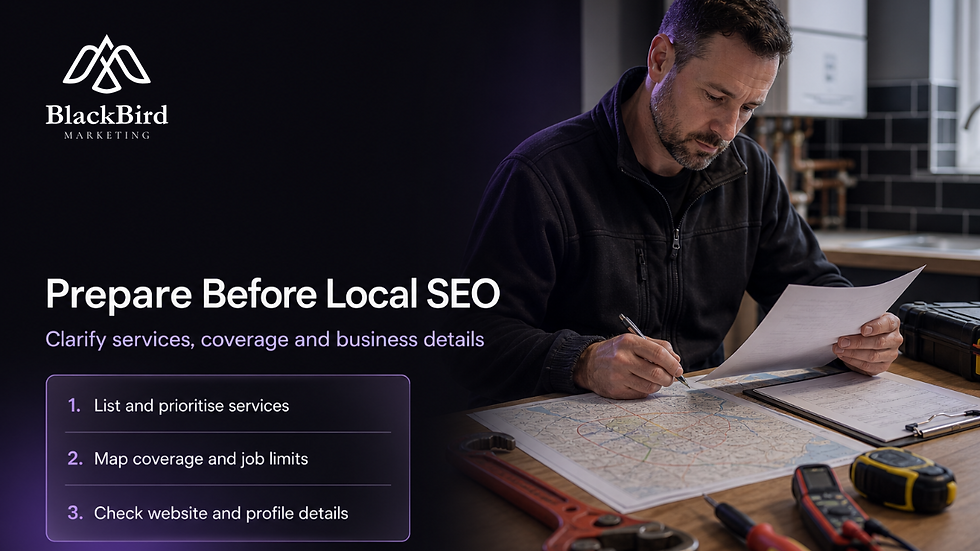
Before starting Local SEO, a trade business should prepare three things properly: its services, its coverage area and the information customers will use to decide whether to make contact. If those details are vague or inconsistent, optimisation can attract the wrong enquiries or make it difficult for search engines to understand the business.
If this is the stage you are working through, you can also use What Should a Trade Business Ask About Local SEO Progress for the next practical checks.
In short: write down exactly what you do, where you do it and which jobs you want more of before changing your website or Google Business Profile. Clear business information gives Local SEO a sound base and helps prevent wasted effort.
Start with a precise list of trade services
The first preparation task is to separate your genuine services from vague descriptions. “Plumbing”, “electrical work” or “building services” may be accurate at a broad level, but they do not tell a customer or search engine which jobs you are equipped and willing to handle.
Make a working list of the services you want the business to be found for. Use ordinary customer language, but keep every item commercially accurate. For example, a plumber may distinguish between bathroom installations, boiler work, leak repairs and heating maintenance. An electrician may separate domestic rewiring, consumer unit work, lighting installation and inspection services.
Do not add a service simply because people search for it. A broader keyword list is not useful if it produces enquiries for work you do not provide, cannot price confidently or do not want to carry out.
Classify each service before publishing it
For each proposed service, record the following:
The plain-English name a customer would use.
Whether it is a core service, an occasional service or no longer offered.
Whether it applies to domestic, commercial or both types of customer.
Any important limits, such as property type, job size, access or certification requirements.
Whether you want enquiries for it now.
This exercise often exposes services that are listed on an old website but are no longer commercially useful. It can also reveal the opposite problem: profitable work that is carried out regularly but barely mentioned online.
Choose priorities rather than treating every service equally
Local SEO does not require every service to receive the same attention. Decide which services matter most based on factors such as profit, demand, travel burden, availability of staff and the type of customer you want to attract.
A high-value service may deserve a dedicated page and stronger internal links, while a minor service may only need a clear mention on a broader page. This is a business decision, not just a wording exercise.
Also identify services that should not be promoted. If a job is outside your preferred area, creates repeated low-quality enquiries or depends on equipment you no longer use, leaving it prominent can work against the business.
Define coverage without overstating it
Local SEO needs a clear answer to “where do you work?” Prepare a practical coverage list based on where you genuinely accept jobs, not every place that appears within a large radius on a map.
Separate your coverage into useful categories:
Your main town, city or operating area.
Nearby areas you regularly serve.
Locations you may consider depending on the job.
Places you do not normally cover.
Do not create pages for towns where you have no meaningful service presence. Repeating place names without useful local information can make the site less trustworthy and may attract enquiries that are uneconomic to fulfil.
Record the details that change whether a job is viable
Coverage is rarely just a list of postcodes. Consider the factors that affect whether you will accept work:
Maximum practical travel distance.
Whether you charge differently for distant jobs.
Areas served only for larger projects.
Restrictions caused by parking, access or site rules.
Whether commercial and domestic coverage differ.
Whether the business operates from a customer-facing premises or travels to customers.
You do not need to publish every internal rule on the website. However, recording them gives whoever handles your Local SEO a more accurate basis for page planning, service-area wording and enquiry qualification.
Be careful with Google Business Profile information
Your Google Business Profile should describe the same real business as your website. Check the business name, primary category, secondary categories, phone number, website address, opening information and service descriptions.
A service category is not a substitute for a full service explanation, and adding irrelevant categories can create poor expectations. If the business serves customers at their properties, make sure the profile reflects the way the business actually operates rather than implying a walk-in premises that customers cannot visit.
Before making changes, gather access to the profile and confirm who owns it. A Local SEO project can be delayed if nobody knows which email account controls the listing or if an old employee or supplier retains access.
Audit the information customers will see
Local SEO cannot correct basic business information that is inconsistent across the website, Google Business Profile, directories, social profiles and quotation documents. Prepare a simple record of the details that should remain consistent.
At a minimum, check:
Trading name and any legally important naming distinction.
Telephone number and preferred contact method.
Website address.
Email address.
Business address or service-area wording.
Opening hours and holiday arrangements.
Core services and customer types.
If the business has changed its name, phone number, address or domain, keep a note of the old details. Previous listings may still exist, and identifying them can be important when cleaning up local references.
Check whether the website reflects the current business
Before creating new location or service pages, review the existing site. Look for pages that describe services no longer offered, old staff details, outdated opening hours, broken contact forms and calls to action that lead nowhere.
Check the site from a customer's point of view. Can someone quickly understand what you do, where you work and how to ask about a job? If the answer is no, adding more SEO text may make the site larger without making it more useful.
Mobile presentation matters because a customer may view the site while standing on a job, dealing with a property issue or comparing several contractors. Check that phone links work, forms are usable, important service information is not hidden and pages load without avoidable distractions.
Blackbird Marketing's published website design information describes a review, plan, build and launch or improvement process. That is a useful model to ask about when website changes form part of the SEO work, while remembering that a published website process does not automatically establish the exact workflow for every SEO project.
Prepare evidence that supports trust
Local visibility is not only about service names and locations. Customers also need enough information to judge whether contacting the business is sensible. Prepare genuine material that can support that decision.
Useful material may include:
Clear photographs of completed work, where permission has been obtained.
Short descriptions of the type of property or job involved.
Customer reviews published through appropriate platforms.
Details of relevant qualifications or registrations, where current and applicable.
Common questions customers ask before booking.
Information about what the customer should provide when requesting an enquiry.
Do not manufacture project details, locations or results to make a page appear more local. A smaller amount of specific, accurate information is more useful than a large collection of generic claims.
Organise photographs and job information
Create a folder of approved images with a note explaining what each image shows. Record the service, general area if it is safe and appropriate to mention, property type and any details that can be published.
Avoid uploading photographs that reveal customer addresses, personal information or unsafe work conditions. Ask for permission before using customer premises or identifiable people in marketing material.
These records also make future content easier to check. Without them, it is easy for a page to describe a job too generally or make an unsupported claim about the business's experience.
Decide what a good enquiry looks like
Before measuring Local SEO, agree what counts as a useful enquiry. A phone call is not automatically a successful outcome if it comes from outside the coverage area or concerns work the business does not accept.
Define the details that matter, such as:
The service requested.
The customer's location.
Domestic or commercial requirement.
Urgency, where relevant to the type of work.
Approximate project size or job context.
Whether the customer found the business through the website, Google profile, referral or another source.
Keep this practical. The purpose is to improve decisions and reporting, not to create a complicated scoring system that nobody uses.
Make contact routes ready before promotion begins
Test every route that Local SEO may send people towards. Submit a website form, call the displayed number, check email delivery and confirm that enquiries are visible to the right person.
Decide who will monitor enquiries and what information should be collected on the first contact. If the business cannot respond consistently, increasing visibility may simply create a backlog or missed opportunities.
Do not promise a response time on the website unless the business can maintain it. Use accurate wording about how customers should make contact and what information helps the business assess the job.
Gather access and previous marketing information
Prepare access details before appointing an SEO provider, but share them securely rather than sending passwords through an unprotected message. Relevant accounts may include Google Business Profile, website content management, domain and hosting, analytics, Search Console and call-tracking systems.
Ask for access to be granted to named users where possible. Keep ownership with the business and remove former suppliers or staff who should no longer have control.
Also collect information about previous work:
Past website domains and redesigns.
Previous SEO or advertising activity.
Known Google Business Profile suspensions or verification problems.
Manual changes made to service or location pages.
Existing reports, rankings or enquiry records.
Any recent business name, address, service or coverage changes.
This history can explain sudden changes in visibility and helps avoid undoing useful work. It also gives an SEO provider a better starting point than a blank assumption that the current website tells the whole story.
If the business is changing its offer or service area, it is worth documenting those changes separately before work starts. The published guide How to Brief Blackbird Marketing When Your Trade Business Is Changing is a related reference for that situation.
Turn the preparation into a usable brief
A good Local SEO brief does not need to be long. It should give the person doing the work enough information to make sensible choices and identify what still needs checking.
Include:
The business name and contact details that should be used.
The core services, priority services and services not offered.
The genuine coverage area and any job-size restrictions.
The main customer types and properties served.
Preferred enquiry routes and who manages them.
Existing website, Google Business Profile and account access.
Relevant photographs, reviews and project information.
Known changes, problems or previous marketing activity.
The business outcomes that matter, such as better-fit enquiries rather than visibility alone.
Leave uncertain points clearly marked. It is better to write “confirm whether commercial work is still accepted in this area” than to present an assumption as a fact.
Once the basics are recorded, you can have a more useful discussion about whether the next step should be service-page improvements, technical work, Google Business Profile attention, content, paid advertising or a combination. Blackbird Marketing lists SEO marketing services for trades and local businesses, including Local SEO for Trades, SEO for Plumbers and SEO for Electricians; the exact work still needs to be matched to the business's actual services and coverage.
Questions to ask before Local SEO starts
Use the first conversation to test whether the proposed work reflects the business rather than a generic trade template. Useful questions include:
Which services and locations will be prioritised first, and why?
How will you avoid attracting enquiries for work we do not provide?
What information do you need from us to verify service and coverage claims?
Which website, Google Business Profile and analytics access will be required?
How will relevant enquiries be distinguished from irrelevant calls or form submissions?
What changes will need our approval before publication?
What should we update if our services, staff or coverage changes?
Be cautious of any plan that recommends a large number of location pages without first understanding where the business works, or that treats rankings as the only measure of success. Local SEO should support a clear commercial offer, not replace one.
Ready to turn your trade information into a clear SEO plan? Contact Blackbird Marketing with your services, coverage and priority enquiries ready to discuss. View the SEO marketing services.


