.png)
.png)
.png)
What Should a UK Trade Business Include on a Service Area Page?
By Blackbird Marketing
A service area page should do more than repeat a town name alongside your trade. It needs to answer a customer’s practical questions: do you cover my area, do you carry out the work I need, and how do I get a quote or arrange a visit?
In short: include clear coverage information, the services you provide, genuinely relevant local detail, evidence that supports your work and an obvious next step. Do not create dozens of near-identical pages with only the location changed.
What is a service area page?
A service area page explains where a trade business works and what it offers in those areas. It is different from a general services page, which focuses mainly on the work itself, and from a contact page, which focuses on getting in touch.
For example, a plumber, electrician, builder or roofing company might have:
a main page explaining its services;
individual service pages covering specific types of work; and
service area pages explaining where those services are available.
A service area page can be useful for customers who search for a trade in a particular town or county. It should also help people who have reached the page from your main navigation, a Google Business Profile or a recommendation.
What should a trade service area page include?
1. A clear statement of the area covered
Put the main location or service area in the page title and opening paragraph, but make the coverage specific. Explain whether you cover:
one town or a group of nearby towns;
a wider county or region;
certain postcodes or districts; or
an area subject to a distance, access or project-size limit.
Do not suggest that you cover every nearby place if that is not how the business operates. A misleading service area creates poor enquiries and can waste time for both the customer and the contractor.
If the business charges differently for work outside its usual area, or only accepts larger projects further away, say so plainly. The exact policy will depend on the business, so this should be based on its real operating arrangements rather than a standard statement.
2. The services available in that area
List the actual work customers can book or enquire about in the area. Keep this relevant to the page rather than pasting the full contents of the website.
A useful section might cover:
the main service, such as rewiring, boiler repairs, roofing or extensions;
common related jobs;
domestic, commercial or industrial work, where applicable; and
any work the business does not take on.
Be careful with broad wording. A business may offer a service generally but not provide it in every area, or may only take on certain project types outside its core patch. The page should reflect what the team can realistically deliver.
3. Practical information about working in the area
Customers often need more than a list of services. Explain any local or operational factors that affect the job, such as:
parking, access or restricted roads;
older housing stock or common building types, if genuinely relevant;
rural travel, outbuildings or larger properties;
commercial premises, landlords or property management work; and
whether an initial assessment is normally needed before a price can be given.
Only include details the business can stand behind. Local references should help a customer understand the work, not exist simply to add place names to the page.
4. A realistic explanation of the process
Set out what happens after someone makes contact. For example, the page could explain:
what information the customer should provide;
whether photos, measurements or plans may be useful;
how the business assesses the job;
when a site visit may be needed; and
what the customer can expect before work starts.
Avoid promising a fixed response time, quote time or appointment date unless the business has confirmed that it can consistently meet it. It is better to explain the process accurately than to use a promise that creates the wrong expectation.
5. Evidence that is genuinely relevant
Evidence can make a service area page more useful, but it must relate to the business and the type of work being discussed. Depending on what is available, this could include:
photographs of completed work;
case studies describing the problem, work and outcome;
customer reviews used with permission;
details of relevant qualifications or memberships; and
examples of work for similar property types.
Do not invent local jobs, reviews or customer outcomes. If there is no location-specific evidence, use honest business-wide evidence and avoid implying that it came from the area named on the page.
6. Answers to questions customers actually ask
A short FAQ can deal with practical points that might otherwise stop someone enquiring. The questions will vary by trade, but may include:
Do you cover my postcode?
Do you work on domestic, commercial or rental properties?
Can you assess the job before providing a price?
Do you take on small repairs as well as larger projects?
What information should I send with my enquiry?
Are there types of work you do not carry out?
Answer only questions that the business can answer accurately. An FAQ should not be used to add unrelated keywords or make unsupported claims about availability, pricing or guarantees.
7. A simple next step
End the page with a clear action. This could be to call, complete an enquiry form, send photographs or request an assessment, depending on how the business handles new work.
The wording should tell the reader what to do and what information will help. For example, a customer may be asked to include the property type, the area, a brief description of the job and any useful photographs.
Keep the contact option easy to find on mobile. A page that explains the service well but hides the enquiry route is less useful than it should be.
How much local detail is enough?
There is no useful target for the number of times a location should appear. The right amount of detail is enough to make the page genuinely helpful to someone in that area.
Good local content might explain:
the actual boundary of the service area;
which nearby districts are included or excluded;
property or access conditions that affect the work;
how travel or site visits are handled; and
examples of relevant work, where they are available.
It is not useful local content to change a town name in every heading, repeat the same paragraph several times or add a long list of places the business has never worked in.
Should every town have its own page?
Not necessarily. A separate page is more likely to be worthwhile when the business genuinely serves that area and there is enough useful information to make the page distinct.
Before creating another page, ask:
Would a customer in this area receive a different or more useful explanation?
Can the business describe its coverage accurately?
Is there relevant work, property context or process information to include?
Will the page help someone decide to enquire?
Can the business keep the information up to date?
If the answer is no, a well-written wider-area page may be better than a collection of thin pages. Location pages also need internal links that make sense, so customers can move between the main service, relevant areas and the contact route without getting lost.
Common service area page mistakes
Copying the same page for every location
Replacing one place name with another does not create useful local information. It can also leave customers unsure whether the business really works in the area.
Making unsupported local claims
Do not say the business has completed work in a town, understands a local property type or offers a particular level of availability unless that is true and can be supported.
Using vague coverage language
Terms such as “all surrounding areas” can be unclear. Explain the actual service boundary or invite the customer to check their postcode if coverage varies.
Focusing on rankings instead of customers
A page full of place names and trade terms does not replace useful information. The customer needs to understand suitability, process, likely requirements and the next step.
Failing to maintain the page
Service areas change. Teams move, operating costs change and some types of work may no longer be accepted. Review the page when the business changes its coverage, services, contact process or evidence.
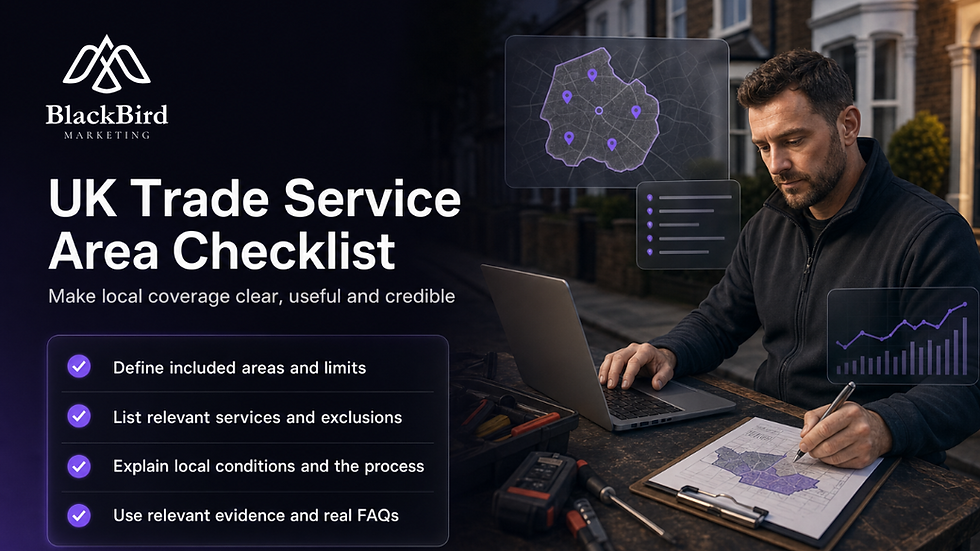
A practical checklist
Before publishing a service area page, check that it:
names the area clearly;
states what the business does there;
explains any meaningful coverage limits;
includes genuinely relevant local or operational detail;
uses only accurate evidence;
answers common customer questions;
has one clear enquiry route;
links to the relevant service pages; and
is sufficiently different and useful to justify being a separate page.
Building service area pages into a wider website
At Blackbird Marketing, we treat service-area pages as part of the enquiry journey rather than isolated SEO pages. The practical test is whether someone can quickly confirm coverage, see the relevant service and understand the next step.
Service area pages work best as part of a clear website structure. A customer should be able to reach them from the relevant service page, understand the work available in the area and move easily to an enquiry page.
For a trade business reviewing its wider site structure, Blackbird Marketing’s website design service covers clearer service pages and routes for customers to enquire. The same review can also identify whether local SEO, service pages or paid activity need to support the area strategy.
If you are unsure whether a new location page is justified, start with the customer’s question rather than the keyword: what would someone in this area need to know before contacting the business? If the page can answer that properly and accurately, it is more likely to earn its place on the website.
Planning service-area pages for your trade business? See Blackbird Marketing’s website design service for help structuring service and location pages around a clear route to enquiry.