.png)
.png)
.png)
What Should Happen During the First Stages of a Local SEO for Trades Campaign?
By Blackbird Marketing
In short: the first stages should establish what work you want, where you genuinely serve customers, how people search for it and whether your website and Google Business Profile support enquiries. The campaign should then turn those findings into a measured, prioritised action plan rather than immediately producing generic pages.
What should happen first in a trades SEO campaign?
The campaign should begin with a commercial and technical review, not a rush to publish location pages. For a plumber, electrician or other trade business, the early work should connect three things: the services you want to sell, the areas you can serve properly and the way potential customers search before making contact.
That normally means agreeing priorities, checking the current website and Google Business Profile, reviewing service areas, researching customer intent, fixing important problems and setting up useful measurement. The result should be a clear order of work and a sensible baseline for judging progress.
Early progress is not just a change in rankings. It may also mean correcting a wrong phone number, making a priority service easier to find, improving a weak enquiry route or discovering that the campaign has been targeting areas that do not produce worthwhile jobs.
1. Agree which work the campaign is meant to win
Before keyword research starts, decide which services deserve attention. A trade business may offer repairs, installations, inspections and maintenance, but those services can have different customers, competition, job values and levels of urgency.
Useful questions include:
Which services do you want more enquiries for?
Which jobs are commercially worthwhile or a good fit for the business?
Are there services you do not want to promote heavily?
What makes an enquiry useful: a phone call, form submission, booking or quotation request?
How will a lead be judged after the first contact?
This prevents the campaign becoming an attempt to rank for every trade-related phrase. A focused starting point also makes it easier to decide whether the next priority should be a service page, a technical fix, a profile improvement or better lead tracking.
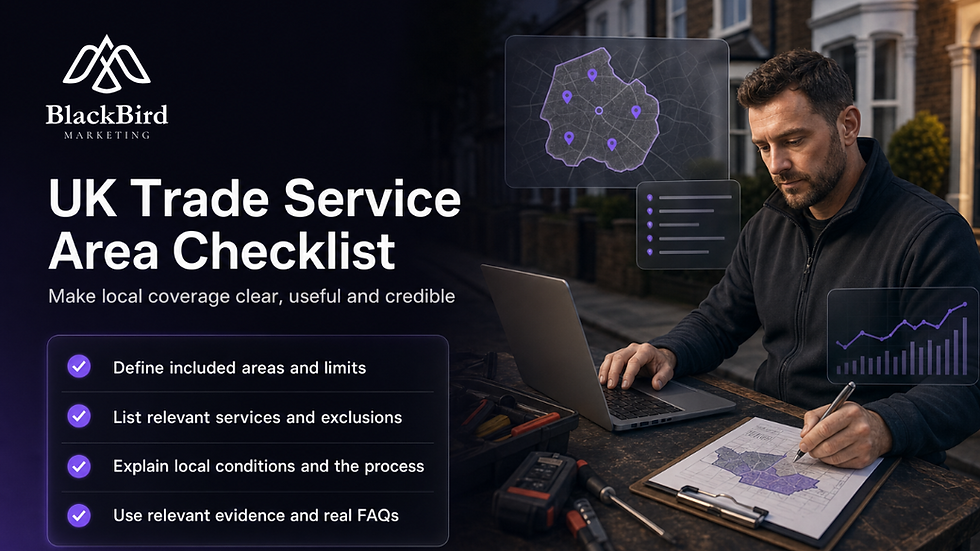
2. Decide which service areas are worth targeting
Local SEO needs accurate location decisions, but adding place names to pages is not a strategy by itself. The campaign should separate areas the business genuinely serves from places where visibility is unlikely to produce profitable or manageable work.
Travel time, job size, type of service and local competition may all affect the decision. For example, a business might consider a larger planned installation across a wider area than a small repair, provided that the wider work remains commercially sensible.
Not every area needs its own page. Dedicated pages should only be considered where there is a genuine customer or service reason and enough useful information to make the page worthwhile. Thin pages that repeat the same copy with different town names can make the site harder to maintain and less useful to customers.
For a practical way to make this decision, see how tradespeople can prioritise service areas for Local SEO.
3. Record the starting position before making changes
A campaign needs a baseline so later decisions are not based on memory or a single manual search. The review should record the website, local search presence, important pages and the enquiries already being generated.
Checks may include:
Which priority services and areas already have some visibility.
Whether important pages are indexed and easy to reach.
How the business appears in local and map results for relevant searches.
Whether the business name, phone number, website and opening information are consistent.
Which pages generate visits, calls or form submissions.
Whether competing businesses explain the same service more clearly.
Local results can vary by searcher, device and location, so one search from one computer is not a reliable campaign measurement system. Rankings are useful as an indicator, but they should be considered alongside visibility, lead quality and what happens after an enquiry arrives.
4. Check the Google Business Profile and local information
The Google Business Profile should be reviewed alongside the website, because customers may encounter the profile before visiting the site. The first-stage check should confirm that the main business information is accurate and that the profile reflects the work the business actually provides.
Relevant checks include the primary category, additional categories where appropriate, business description, telephone number, website link, opening information, services and photographs. It is also worth checking that the profile points people towards a useful page rather than an outdated or irrelevant destination.
Reviews can be part of the wider process, but they do not replace accurate service information or a usable website. A sensible approach is to request genuine customer feedback and respond appropriately, without treating reviews as something to manufacture or guarantee.
5. Check whether the website can turn local visibility into enquiries
More visibility will not solve a confusing website. A customer should be able to understand what the business does, whether it handles their type of job, where it works and how to make contact without having to search through several unclear pages.
The early website review should ask:
Does each priority service have a clear and useful page?
Can a mobile visitor find the phone number or enquiry route quickly?
Does the page explain what the service involves and who it is for?
Are service areas described accurately and naturally?
Are important pages connected through sensible internal links?
Are there broken links, indexing problems, duplicate pages or confusing navigation?
Do page titles and headings describe the service clearly?
If the existing structure prevents customers from understanding the services or contacting the business, a wider SEO and website structure review for a trade business may need to come before substantial SEO activity. That does not automatically mean rebuilding the site; it means dealing with the parts that obstruct the campaign's main purpose.
6. Research the searches behind real trade enquiries
Keyword research should identify customer intent, not just collect phrases containing a service and a place. Someone searching for an urgent repair is making a different decision from someone comparing a planned installation, inspection or replacement.
The campaign should group searches around the decisions customers are trying to make, such as:
What service is needed?
How urgent or serious might the problem be?
Does the business handle this type of job?
What information will be needed before a quotation?
Which service area and contact option are relevant?
This research helps decide whether the site needs a stronger main service page, a separate page for a materially different service, or useful supporting content answering a question customers raise before calling. It also helps avoid writing generic blog posts that attract attention but do not support the work the business wants.
7. Fix the problems that affect visibility or contact
Once the review is complete, the first practical changes should be prioritised by their likely effect on customers and important pages. Typical early actions might include correcting business details, repairing a broken form, improving a priority service page, fixing internal links or resolving an indexing problem.
Not every technical recommendation deserves immediate attention. A minor issue with no clear effect on an important page may reasonably come after an incorrect telephone number, a missing service page or an enquiry form that does not work.
Each action should have a reason attached to it: what is wrong, which customer or page it affects, what will change and how the result will be checked. This is more useful than receiving a long list of technical terms without an order of priority.
8. Set up lead tracking before ongoing work begins
Tracking should be checked before the campaign creates more visibility. Otherwise, it becomes difficult to tell whether changes have produced worthwhile enquiries or simply increased visits.
Depending on the business, useful measures may include website calls, contact forms, booking actions, clicks on contact details and relevant Google Business Profile actions. The business should also record what happens after contact, because a marketing report cannot show the full value of a lead if every enquiry is treated as identical.
Agree the main measures at the start. For one business, a phone call may be the key action; for another, the important distinction may be whether the enquiry relates to the right service, area and type of job.
9. Turn the review into a staged plan
The first stage should finish with a written order of work. It should be clear which issues are immediate, which improvements come next and which activity can wait until the foundations are in place.
A sensible sequence might be:
Confirm priority services, customers and commercially relevant areas.
Correct important business, contact and profile information.
Fix serious website, indexing or enquiry problems.
Improve the main service pages and their internal links.
Strengthen supporting local information and customer-facing content.
Review visibility, enquiries and lead quality before changing priorities.
The exact order will depend on the findings. A business with a sound website but weak service coverage has different needs from one with useful content but an unreliable contact process.
What should not happen at the beginning?
A campaign should not start with promises of immediate rankings, hundreds of near-identical location pages or a fixed list of generic articles unrelated to the work the business wants. It should also avoid making many changes at once without recording what was changed.
When the website, profile and tracking are altered together without a clear plan, it becomes harder to understand which change helped and which introduced a new problem. The business should be able to see what is being targeted, why it matters, what has been done and how progress will be assessed.
Blackbird Marketing's recorded services include Local SEO for Trades, SEO for Plumbers, SEO for Electricians, Digital Marketing for Tradespeople and PPC for Trades. No topic-specific published case evidence or results were supplied for this article, so the sensible test remains the quality of the plan, the clarity of the work and the relevance of the leads being measured.
Need help planning the first stages of Local SEO?Discuss your Local SEO campaign with Blackbird Marketing. A clear review can show whether the site is ready to support the services, areas and enquiries the campaign is meant to target.