SEO for Electricians or PPC for Trades: Which Should You Choose?

By Blackbird Marketing
In short: PPC is usually the better fit when you need controlled visibility and enquiries quickly; SEO is better for building organic demand that can continue after individual campaigns stop. Many electricians should assess both, but the balance depends on lead value, competition, website quality, tracking and available budget.
SEO for electricians and PPC for trades answer different questions
When someone searches for an electrician, they may need help immediately, be comparing firms for planned work, or be researching a future project. SEO and PPC reach those searchers in different ways, so the better option is not simply the one with the lowest apparent cost.
SEO for electricians aims to improve a business's visibility in unpaid search results and relevant local searches. It can involve the website, service pages, technical setup, local business information and useful content. PPC for trades uses paid advertising to place selected adverts in search results, usually with control over budgets, targeting and the search terms or audiences being pursued.
The practical comparison is this:
Choose PPC when: you need visibility for a specific service, want to test demand or need a campaign that can be started and adjusted relatively quickly.
Choose SEO when: you want to strengthen your website and organic visibility over time, reduce reliance on paid clicks and support several relevant services or locations.
Consider both when: you need short-term lead generation but also want to build a more durable source of enquiries.
Neither channel should be judged only by clicks. An electrician needs to know whether the activity produces suitable enquiries, whether those enquiries become profitable work and whether the business can answer them properly.
When PPC may make more sense
PPC can be useful when a business has a clear service to promote and wants more control over where its advertising budget is spent. It can be particularly relevant when organic visibility is weak, a new website has not built search authority yet, or the electrician wants to test a particular service before investing more heavily in content and SEO.
Speed and control
Paid search can provide visibility without waiting for a new page to establish itself in organic results. That does not mean every campaign will perform well immediately, but it does allow decisions about budget, targeting, adverts and landing pages to be made in a more controlled way.
For example, a campaign might focus on one service rather than sending every visitor to the homepage. This makes it easier to ask whether the advert, page and enquiry process are aligned with the customer's actual search.
The cost is linked to clicks and conversion quality
PPC costs are not limited to the advertising platform. The total cost can include campaign management, advert testing, landing page work, conversion tracking and the time spent handling enquiries. A campaign that generates clicks but poor-fit leads may still waste money.
Before starting, work out what a suitable enquiry is worth to the business. That does not require a perfect forecast, but it does require sensible questions:
What type of work is the campaign intended to attract?
What is the approximate value or margin of a typical suitable job?
How many enquiries can the business handle properly?
What counts as a conversion: a phone call, form submission, booked survey or something else?
How will missed calls, repeat enquiries and unsuitable jobs be recorded?
These questions help separate a campaign that produces commercial opportunities from one that merely produces activity in an advertising account.
PPC can be a useful testing tool
Paid campaigns can help test which services, messages and search terms attract attention. However, a short test should not be treated as proof that every related search will produce profitable work. Results can change with location, competition, advert wording, landing page quality, budget and the quality of the tracking.
If the customer journey is unclear, more clicks will not solve the underlying problem. The page should make the service clear, explain what the visitor should do next and provide a straightforward way to enquire.
When SEO for electricians may be the stronger long-term choice
SEO is often more suitable when an electrician wants to build a useful website and organic presence around several related customer needs. It is not a switch that guarantees immediate enquiries. It is an ongoing process in which the site, local information, content and technical foundations need to support one another.
SEO can support more than one search journey
A well-planned site may help people who are looking for a service now, comparing providers or checking whether a business appears suitable for a planned project. Service pages, location information and clear explanations can all contribute to the visitor's decision, provided they reflect what the business genuinely offers.
That wider role is one reason SEO should not be reduced to adding keywords to a page. The website needs to explain the service in plain language, make contact details easy to find and give search engines enough reliable information to understand the business.
SEO usually needs more patience and stronger foundations
Organic visibility can take time to improve, particularly where competing businesses already have established websites and local profiles. The work may include technical checks, page structure, content, internal linking, local search information and improvements to the enquiry journey.
The starting point matters. A site with unclear services, weak pages, poor mobile usability or no reliable conversion tracking may need practical website work before additional content can do much. Blackbird's published website design information describes a review, plan, build and launch or improvement process, which is a useful structure to ask about when assessing whether a marketing provider is addressing the site as well as the traffic.
For a broader view of the decision, see this guide to reviewing local SEO, PPC and digital marketing for a trade business. The important point is to review the channels together rather than assuming one tactic will fix every commercial problem.
How to compare the two channels properly
A comparison based only on monthly spend is incomplete. SEO and PPC distribute cost and risk differently, so the evaluation should cover the full route from search to sale.
1. Compare the type of demand
Look at whether the search suggests immediate need, planned work or general research. A person searching for an electrician urgently may respond differently from someone comparing options for a larger project. Both channels can reach relevant people, but the advert or page needs to match the intent.
Ask whether the campaign or SEO plan is focused on the services the business actually wants. Broad visibility can be less useful than a smaller amount of highly relevant traffic that the business can serve well.
2. Compare the time horizon
PPC is generally considered when the business needs a campaign that can be adjusted around current demand. SEO is considered when the business is prepared to improve its online foundations and build visibility over a longer period.
Do not accept a fixed ranking or enquiry timetable without evidence. Timing can be affected by the starting condition of the website, competition, search demand, location, content quality and the consistency of the work.
3. Compare total cost, not just media spend
For PPC, include click costs, management, landing page changes and tracking. For SEO, include strategy, technical improvements, content, website changes and ongoing review. The cheapest monthly option may not be the most efficient if it leaves the main conversion problem untouched.
Also consider the cost of stopping. Paid traffic normally stops when the campaign or budget stops. SEO work may leave useful improvements on the website, but continued visibility is not automatic and still depends on maintenance, competition and the quality of the site.
4. Check lead quality and capacity
A successful channel is one that produces enquiries the electrician wants and can handle. If the business is already struggling to answer calls, attend surveys or follow up quotes, increasing traffic may create a different operational problem rather than improving results.
Agree how lead quality will be reviewed. Useful categories might include relevant service, location, job suitability, contact made, quotation provided and work won. The exact system can vary, but the marketing decision should use more than impressions and clicks.
5. Check the website before increasing traffic
Paid visitors and organic visitors both need a clear destination. Check that the relevant page:
states what service is being discussed;
matches the wording and intent of the search;
shows a clear contact route on mobile;
uses accurate business details;
sets sensible expectations about the enquiry;
allows calls and forms to be tracked where appropriate.
If an advert sends people to a generic homepage, or an organic page does not explain the service clearly, the problem may be the customer journey rather than the traffic source.
A sensible decision framework for an electrician
Start with the business constraint rather than the channel label. The following questions should produce a more useful decision than asking whether SEO or PPC is universally better.
Do you need visibility for a specific priority service now? If yes, assess PPC, but only after checking the landing page, budget and conversion tracking.
Is the website difficult to understand or poorly structured? Fix the foundation before expecting either paid or organic traffic to perform well.
Do you want visibility across several services over time? SEO may provide the more suitable long-term framework, provided the investment and timescale are realistic.
Can you handle additional enquiries? If capacity is limited, improve qualification and follow-up before increasing demand.
Can you measure suitable enquiries rather than just visits? If not, agree the measurement approach before spending more.
Would a combined approach reduce risk? A controlled PPC campaign can support immediate testing while SEO improves the website and organic presence, but both should have separate objectives.
A combined approach is not automatically better. Running two poorly tracked channels can make the budget harder to understand. It works best when PPC has a defined role, SEO has a clear improvement plan and the business reviews actual enquiries rather than treating all traffic as equal.
Questions to ask a marketing provider
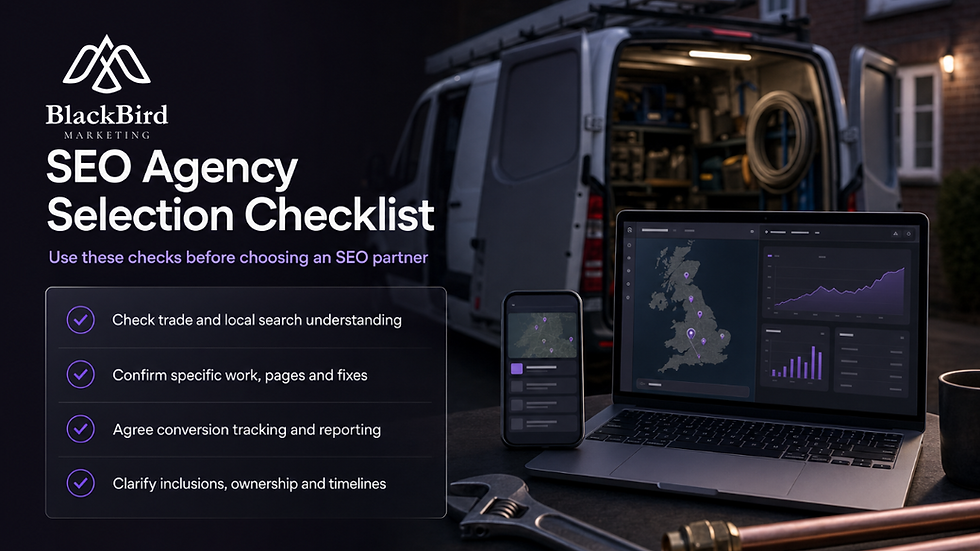
An electrician should be able to understand what will be done, what assumptions are being made and how decisions will be reviewed. Ask:
Which services and customer searches are being prioritised, and why?
What needs changing on the website before traffic is increased?
How will phone calls, forms and unsuitable enquiries be treated in reporting?
What is included in the PPC budget, and what is separate management or website work?
What SEO work is planned beyond publishing generic articles?
How will the plan change if the first set of enquiries is poor quality?
What information will the business need to provide about profitable jobs and capacity?
Be cautious of promises that focus only on rankings, clicks or a guaranteed number of leads. Those measures may be relevant, but they do not by themselves show whether the marketing is producing the right work.
When the need is broader than one campaign, Blackbird's listed SEO marketing services can be considered alongside the website and paid advertising requirements. The useful next step is to discuss the business's priority services, existing website and measurement needs rather than choosing a channel in isolation.
Which should you choose first?
Choose PPC first when there is a clearly defined service, a suitable landing page, a workable budget and a need to test or generate demand without relying solely on organic visibility. Set a sensible review method before the campaign starts.
Choose SEO first when the business wants to strengthen its website, improve its organic foundations and build a longer-term search presence. Make sure the plan covers the customer journey and technical setup, not just keywords.
If both immediate and longer-term needs matter, use separate objectives for each. PPC can answer short-term questions about demand and messaging, while SEO improves the asset that customers reach and builds a broader organic base. Review both against relevant enquiries and commercial fit.
Want to compare the right route for your trade business? A clear review of your website, priority services and lead tracking can show whether SEO, PPC or a combination is the sensible next step. Review Blackbird's SEO marketing services